

The Real EV Battery Problem Isn’t Degradation
One of the biggest fears around EVs has always been battery degradation.
When people think about battery degradation, they usually think about smartphones. We’ve all experienced a phone battery that slowly becomes frustrating to live with — reduced runtime, slower charging, overheating, and eventually the feeling that the device is constantly tethered to a charger.
So it seems reasonable to assume EVs will follow the same path. If lithium-ion batteries degrade in phones, surely second-hand EVs are destined to become expensive liabilities with declining range and enormous replacement costs.
But the real-world data tells a different story.
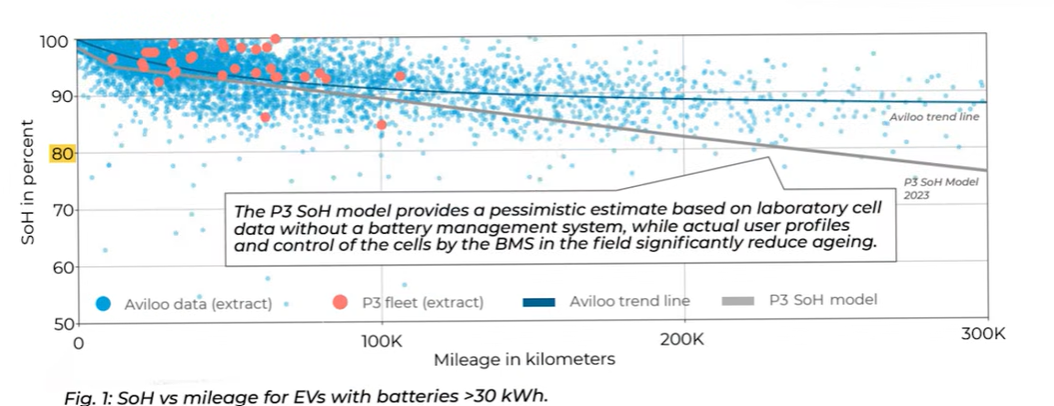
Real-world data shows that EV batteries follow a different degradation pattern to smartphones. Source: Timilsina et al 2023
Modern EV batteries are holding up remarkably well. In many cases, far better than early critics expected. The bigger issue emerging now isn’t catastrophic degradation — it’s uncertainty. Buyers, sellers and even regulators are still struggling with how battery health should actually be measured, reported and trusted.
Without trusted battery health data, every used EV starts to feel like a gamble.
EV Batteries Are Lasting Longer Than Most People Expected
One of the most useful large-scale datasets comes from a 2025–2026 study by Geotab, which analysed more than 20,000 real-world EVs. The study found average battery degradation of around 2.3% per year.
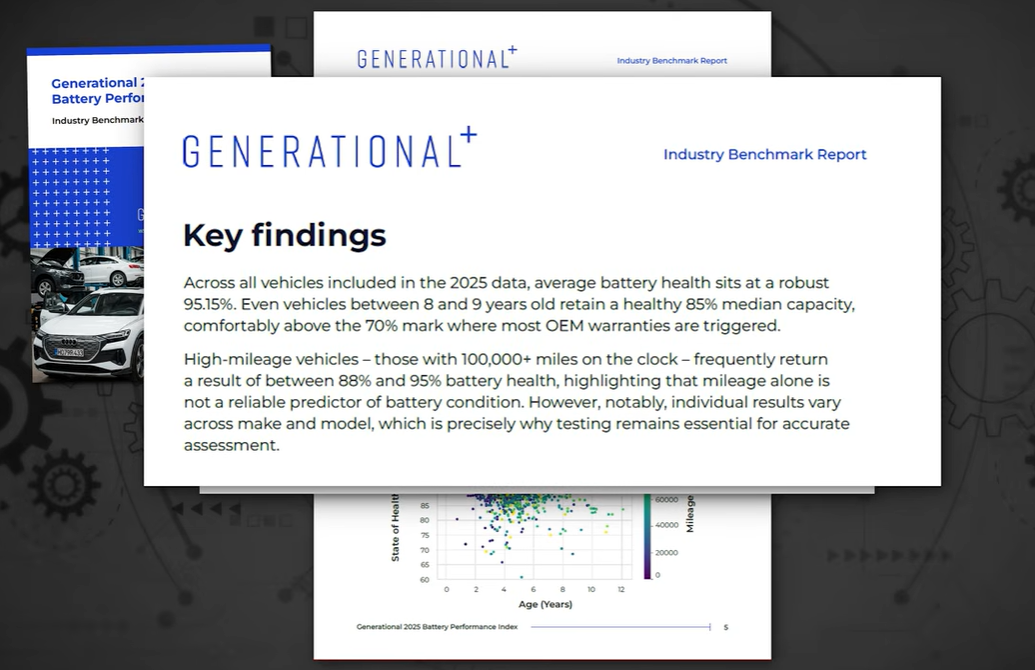
Another major dataset — the Generational 2025 Battery Performance Index — looked at more than 8,000 electric cars and vans up to 12 years old and found a median battery health of 95.15%.
Even older vehicles are performing surprisingly well:
EVs aged 4–5 years showed median battery health around 93.5%
8–9 year old EVs still retained roughly 85% of original capacity
Many vehicles with more than 100,000 miles still retained close to 90% battery health
That is a very different picture from the “dead battery after a few years” narrative that still dominates many conversations about EVs.
Part of the reason is that while phones and EVs both use lithium-ion chemistry, the systems surrounding those batteries are completely different.
Phones are routinely exposed to high temperatures, rapid charging, constant full charges and minimal thermal management. EVs, by contrast, actively manage battery temperature, charging behaviour and operating windows to reduce stress and extend lifespan.
Most EVs never allow the battery to access its true physical limits. Manufacturers build in “buffer zones” that prevent the cells from fully charging or fully discharging, significantly reducing long-term degradation.
What Actually Causes Battery Degradation?
Battery degradation is real. The question is not whether it happens, but what accelerates it.
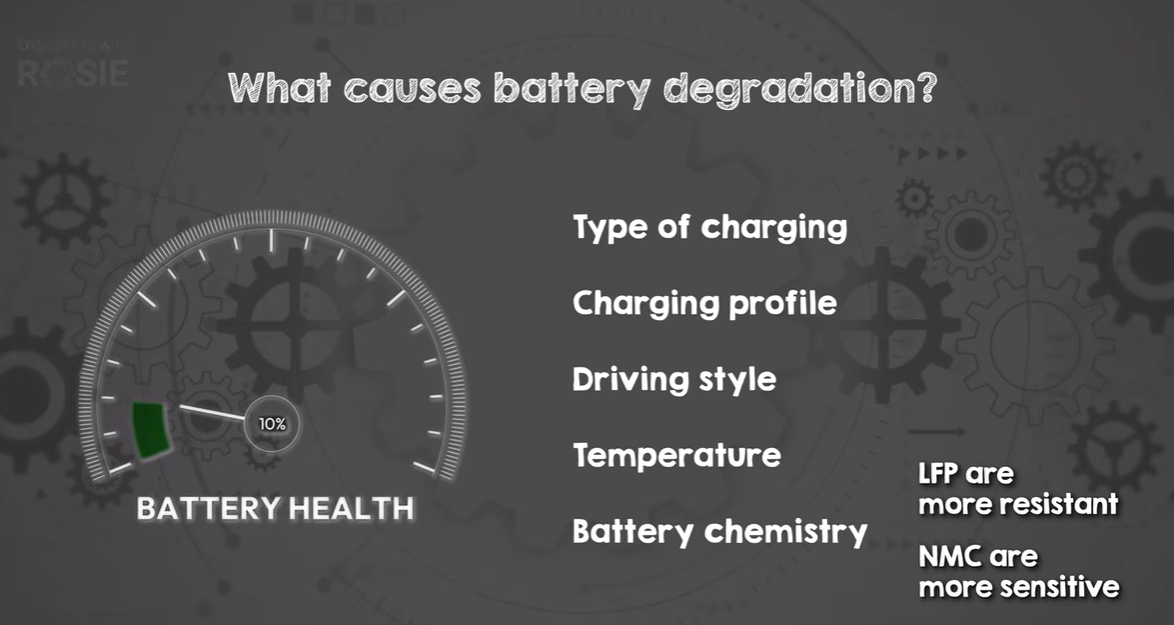
What are the main factors that accelerate battery degradation?
One of the clearest factors appears to be frequent ultra-fast DC charging. The Geotab dataset found that vehicles relying mostly on slow charging degraded at closer to 1.5% per year, while vehicles frequently using DC fast charging saw degradation rates closer to 3% annually.
Temperature also matters enormously.
Lithium-ion batteries operate best within a relatively moderate temperature range (between 15°C and 35°C). Excessive heat accelerates chemical side reactions inside the battery, while very cold conditions can lead to lithium plating during charging.
That has important implications for markets like Australia, where high ambient temperatures can place additional stress on battery systems.
Another commonly misunderstood factor is state of charge. Batteries generally experience less stress when operating within the middle portion of their charge range. However, advice around this is often oversimplified. Occasionally charging to 100% is not inherently harmful and can actually help battery management systems recalibrate and balance cells. The bigger issue is leaving batteries sitting at very high states of charge for extended periods.
Interestingly, recent Stanford research also challenged another common assumption: that gentle, steady driving is always best for battery longevity.
The study found that more dynamic driving patterns — including stop-start traffic, regenerative braking and varying loads — may actually improve long-term battery life compared to perfectly steady discharge patterns. Researchers suggested that these “micro-rests” allow lithium ions to redistribute more evenly within the battery.
Battery Degradation Is Not Linear
Another important point often missed in public discussions is that EV battery degradation does not happen in a straight line.
Instead, batteries tend to follow an “S-curve” pattern. There is usually a relatively noticeable drop in capacity early in life as the battery chemistry stabilises, followed by a long period of slow, predictable degradation. Only near the very end of the battery’s usable life does degradation accelerate sharply again.
The initial drop is largely associated with formation of the Solid Electrolyte Interphase (SEI) layer — a protective layer that forms naturally during early charge cycles. While this process permanently consumes some lithium, it also helps stabilise the battery over the long term.
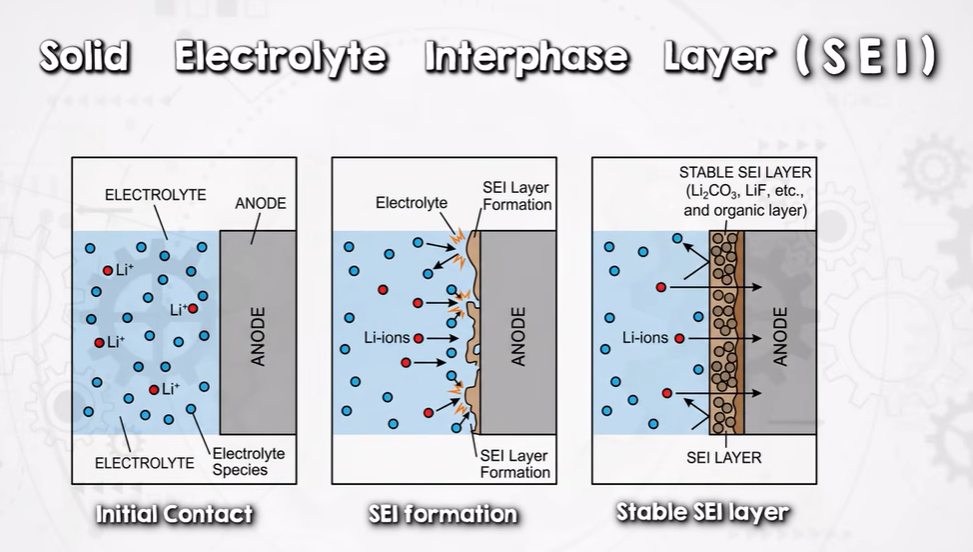
The sharp initial drop in an EV battery's capacity typically occurs during the first 30,000 kilometres of driving and is mainly due to the formation of a Solid Electrolyte Interphase layer
This means that seeing some early reduction in capacity is normal and does not necessarily indicate a rapidly failing battery.
The Worst-Case Scenarios Still Matter
Despite the reassuring averages, outliers do exist.
A small percentage of batteries degrade far faster than expected, and replacement costs can still be extremely high.
The EV Clinic, an independent European EV repair and research lab, analysed manufacturer service catalogues and found that only around 2.5% of EVs had ever required battery replacement. For newer “Gen-3” EVs built after 2022, that figure reportedly drops to around 0.3%.
However, when replacement is required, costs can vary dramatically.
According to EV Clinic’s dataset, replacement battery prices ranged from around €8,400 for a Tesla Model 3 battery pack to approximately €35,000 for a 62kWh Hyundai Kona EV battery.
That creates a risk for second-hand EV buyers. Even if catastrophic failures are rare, buyers still need a reliable way to identify unhealthy batteries before purchase.
The Real Challenge Is Trust
Battery State of Health (SOH) is supposed to provide a simple answer to a simple question: how much usable capacity remains in the battery compared to when it was new?
In laboratory conditions, measuring SOH is highly controlled. Researchers use techniques such as Coulomb Counting, carefully measuring energy flowing into and out of the battery under controlled temperature conditions to determine true remaining capacity.
But car buyers do not have access to laboratory testing.
Instead, they often rely on the vehicle’s onboard battery management system.
Independent testing approaches are now starting to emerge. Some systems use monitored discharge testing through vehicle diagnostic ports, while newer software-based approaches attempt to infer battery health using driving behaviour, charging data, terrain, temperature and energy consumption patterns.
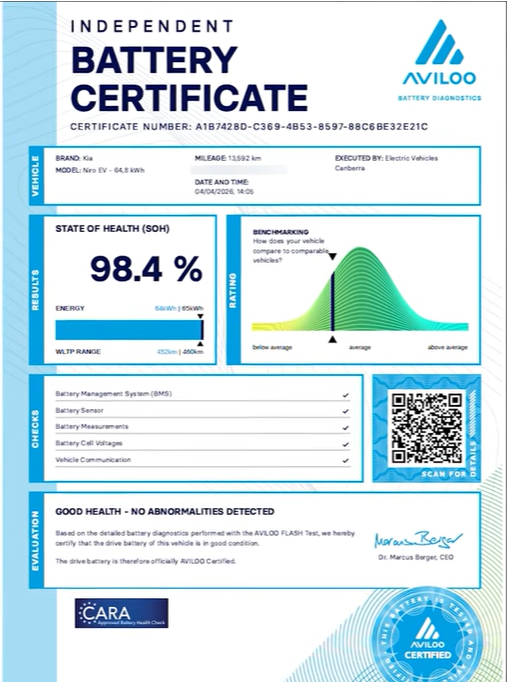
The independent testing I did with Electric Vehicles Canberra showed my second hand EV battery’s SOH as 98.4%
These independent approaches matter because battery health reporting is not currently standardised across manufacturers.
In some cases, manufacturers appear to maintain displayed battery health at 100% for extended periods using hidden battery buffers, making it difficult for owners to understand where the battery truly sits on its degradation curve.
If buyers cannot trust the reported battery health figure, buying a used EV feels much riskier than it should.
Why Standardised Battery Health Reporting Matters
This is increasingly being recognised as a policy issue, not just a technical one.
Europe is already moving toward greater standardisation through upcoming regulations intended to require manufacturers to present battery health information more transparently and validate it against standardised testing procedures.
That may become critical for long-term EV adoption.
Because the main challenge facing used EV markets is no longer whether batteries degrade. The challenge is whether buyers can confidently assess how much degradation has occurred.
Internal combustion vehicles already have mature systems for evaluating condition: service histories, compression testing, mechanic inspections and decades of consumer familiarity.
EVs are still developing those trust mechanisms.
Independent battery testing — combined with transparent and standardised reporting — could become one of the most important pieces of infrastructure supporting the next phase of EV adoption.
Watch this content as a video on Engineering with Rosie on YouTube.
